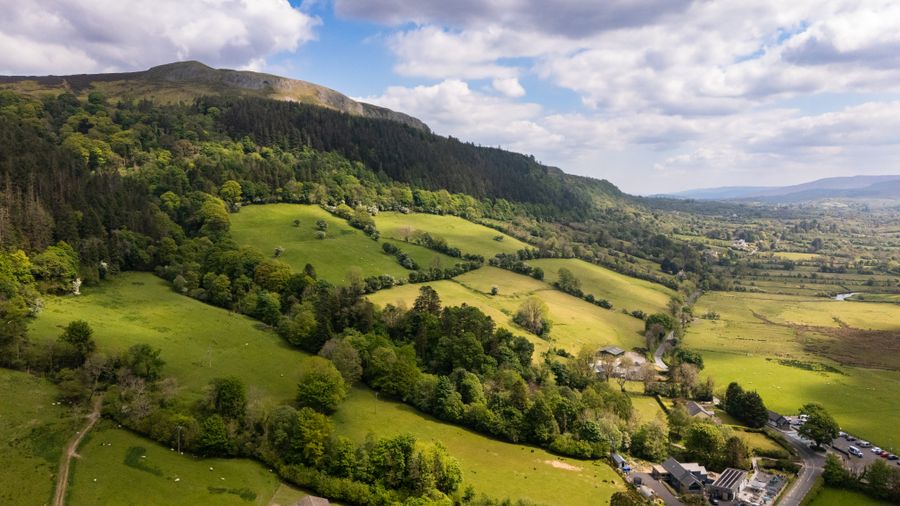
Glendalough's monastic round tower draws coach parties from about 10am, so walk the Green Road before 9am or head instead to the Wicklow Gap on the R756 between Laragh and Hollywood, where the road crosses the mountains at around 470 metres and the only company is usually sheep, cyclists and cloud. The Spinc loop above the Upper Lake takes roughly three hours and thins out sharply after the boardwalk viewpoint. Base in Laragh or Roundwood, both within fifteen minutes' drive of the main entrances; Dublin is about an hour south via the M50 and N81.
Wicklow Mountains: Beyond Glendalough
For a wholly different day, drive the Military Road south from the Sally Gap towards Glenmalure, an eleven-kilometre glen with a hostel at the head and little else. Parking is roadside and free; there are no cafés beyond Laragh. April to June and September give the best balance of light, dryness and low visitor numbers, while October half-term and summer bank holidays fill the Glendalough car park by mid-morning. I would book two nights in Laragh over one in Dublin and treat the city as a bookend.
Killarney: The Lakes Without the Crowds
Killarney National Park covers over 10,000 hectares, and most of its footfall concentrates between the town gates, Muckross House and Torc Waterfall. Walk the Old Kenmare Road west from the car park above Torc for two to three hours and you will pass perhaps a dozen people, with views down over the Upper Lake and the MacGillycuddy's Reeks beyond. Alternatively, take the boat across to Innisfallen Island from Ross Castle and climb to the ruined abbey; sailings run seasonally and are best confirmed in town.
Killarney town has the deepest hotel stock in the region, from guesthouses off New Street to larger properties on the Muckross Road; Kenmare, twenty-five minutes over the pass, is quieter but pricier in high season. The Ring of Kerry road can be slow in July and August, so keep the park for mornings and reserve afternoons for the Gap of Dunloe. Avoid St Patrick's weekend and the August bank holiday if you want empty trails. If I were booking, I would choose three nights in Killarney town and walk everywhere from the door.
Connemara and the Burren: West Coast Scale
Connemara National Park at Letterfrack is small but beautifully served by the Diamond Hill loop, about 2.5 hours return with boardwalk for most of the climb. Parking fills by 11am in summer; arrive for 8.30am and you will meet mostly locals with dogs. The wider landscape delivers the real quiet: the Inagh Valley road between Recess and Leenane, the Sky Road above Clifden, and the beaches at Dog's Bay and Gurteen near Roundstone, roughly twenty minutes from Clifden. Clifden, Westport and Leenane all make sensible bases, with Westport offering the widest choice of hotels.
The Burren in neighbouring County Clare is not a national park in name but a de facto one, and the Poulnabrone dolmen on the R480 attracts tour buses around midday. Come at 7pm instead, or walk the green road east of Carran for limestone pavement without a coach in sight. Note that many Burren roads are single-track with passing places. The Burren Perfumery near Carran is a useful stop for coffee and a map; check opening months before you rely on it. May and early June are the best months for wildflowers and reasonable weather.
Donegal, Ballycroy and the Practicalities
Glenveagh National Park in Donegal is the one people forget, which is the point. The castle and gardens sit at the end of a seven-kilometre access road from Church Hill, with a shuttle bus from the visitor centre; walk it instead and you will have the glen largely to yourself. The Poisoned Glen and Dunlewey beyond Gweedore, about forty minutes west, offer bigger drama with almost no infrastructure. Letterkenny, Dunfanaghy and Dungloe are the realistic hotel bases; a car is essential, and the N56 coast road is slow but scenic.
Ballycroy in County Mayo is Ireland's newest national park and consists almost entirely of blanket bog, with a visitor centre and a handful of marked trails but no facilities beyond that. Bring waterproof boots, water and food. Distances are deceptive: Westport to Ballycroy is around forty minutes, and Belmullet another thirty. Winter daylight is short, so plan walks for mid-morning. Across Ireland's six parks, the pattern is consistent — book a hotel in a gateway town, use it as a base, and be on the trail before nine.