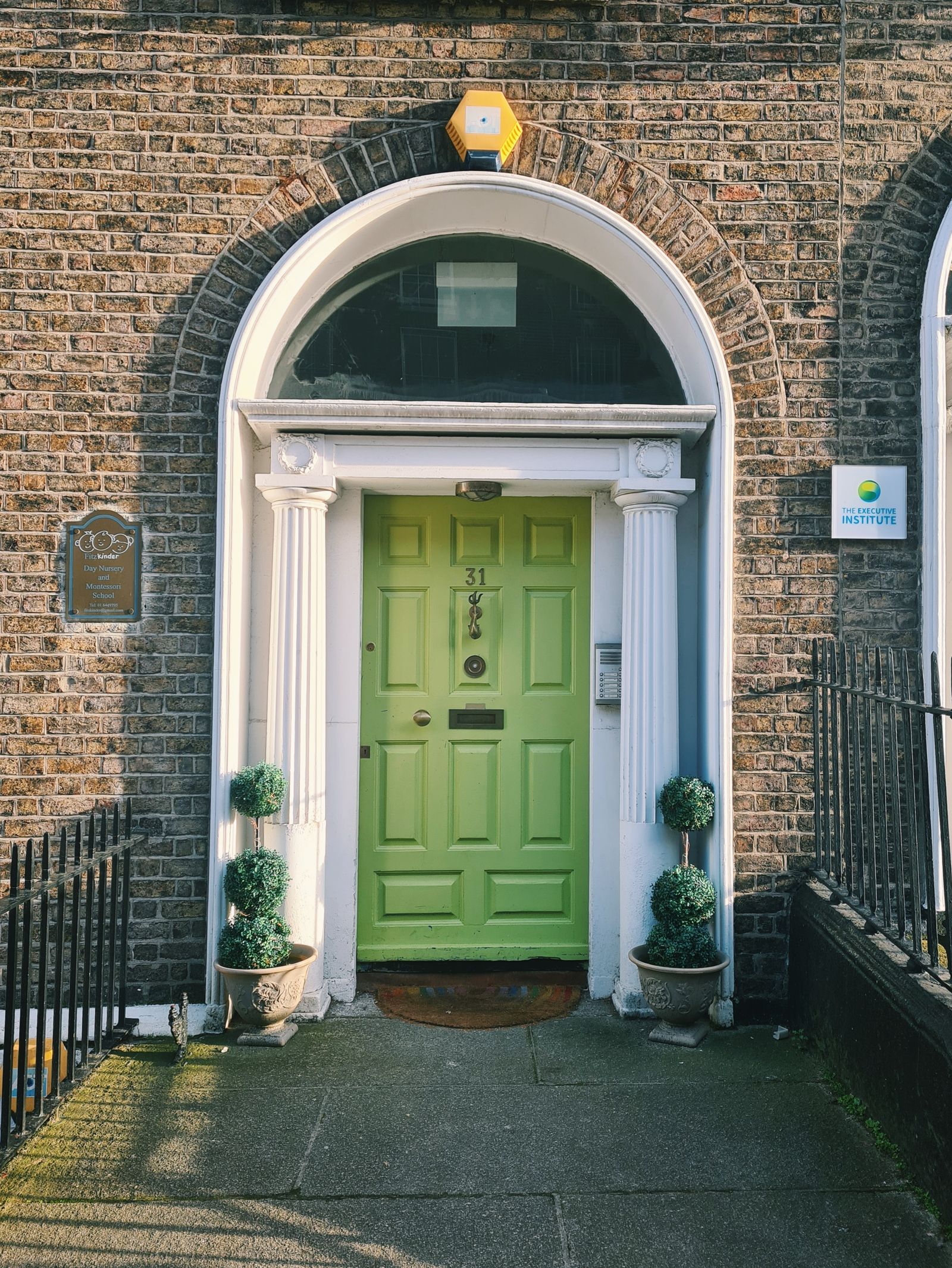
Georgian Dublin is a set of streets and squares laid out in the 18th century, mostly on the south side of the River Liffey. The doorways are the detail most people come to see: painted panels, fanlights above, brass fittings, and steps up to the hall door.
What Georgian means
Georgian Dublin takes its name from the reigns of the British monarchs George I to George IV, a period running from the early 18th century into the 1830s. During that time the city expanded east and south, away from the older streets around the castle, into a planned grid of terraces and squares.
The houses were built in rows, with brick fronts and a strict order to the windows: wide and tall on the first floor, smaller above, smallest at the top. The hall door sat at the top of a short flight of stone steps, with a fanlight over it and a basement below.
The result is a streetscape that reads as a whole rather than as individual buildings. The colour on the doors is a later habit, added over time, and it is what most visitors notice first.
The squares of the south side
Merrion Square and Fitzwilliam Square are the two great set pieces, both laid out with garden squares at their centres. Merrion Square has a public park within it, while Fitzwilliam Square keeps a private garden for the surrounding houses. Around both, the terraces run in long, consistent runs.
St Stephen's Green sits at the western end of this district, with the streets of the south city centre around it. The green itself is a public park, and the terraces on its north and west sides show the same brick and doorway pattern.
Between the squares, streets such as Fitzwilliam Street, Baggot Street and Leeson Street carry the same rows, sometimes interrupted by later buildings. Walking from one square to the next is the easiest way to see the pattern.
Dublin City Council and the Irish Georgian Society both publish material on the city's historic buildings. Check with them before planning a visit around a specific address, as some houses are in private use.
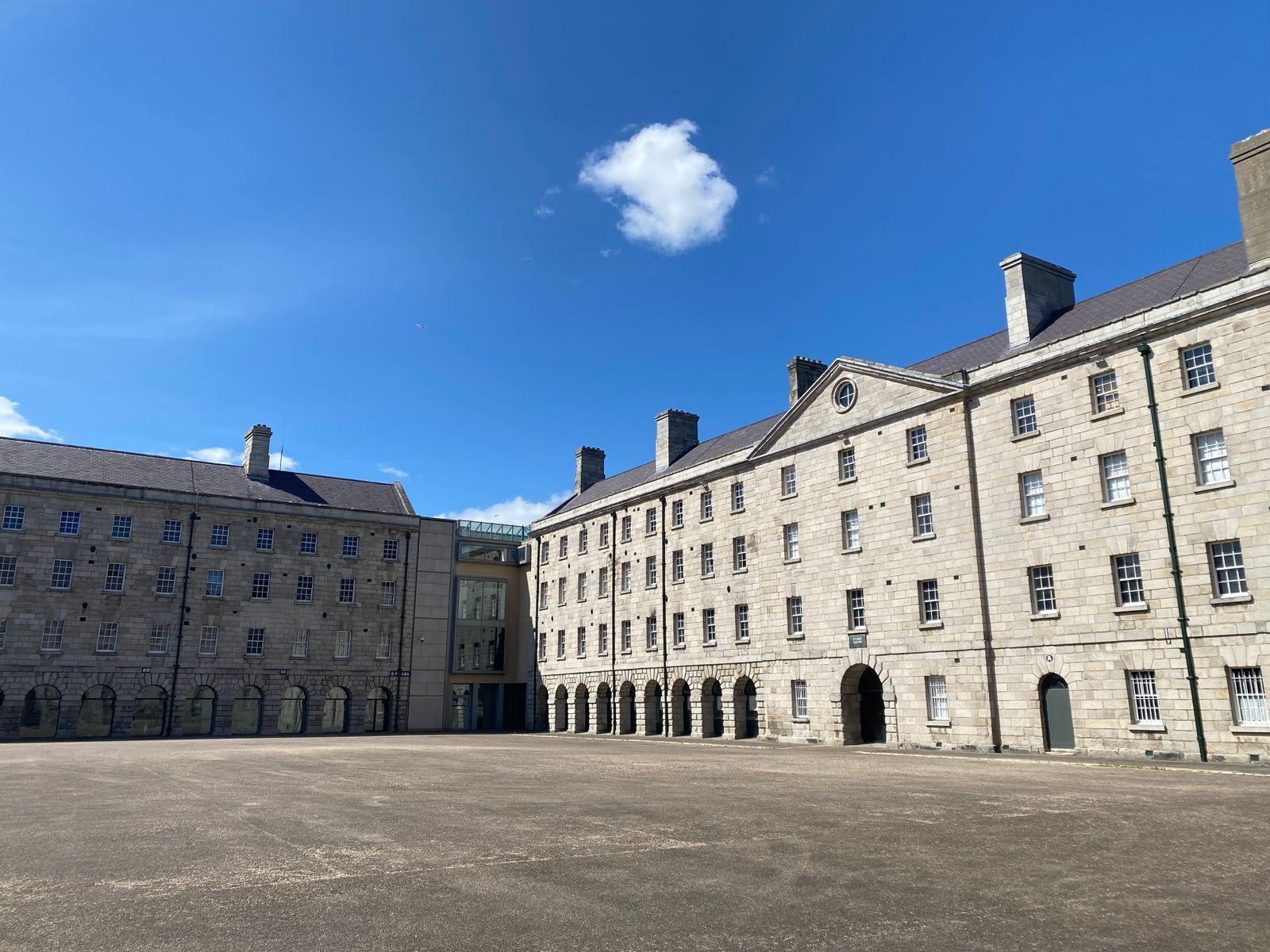
Reading a doorway
Look first at the fanlight, the semicircular or elliptical window above the door. Many are delicate webs of thin glazing bars, and some carry a decorative pattern in the glass. Above the fanlight, a cornice or a small pediment often projects from the brick.
The door itself usually has six or eight panels, painted in a strong colour. The brass is the other giveaway: a knocker, a letter plate, a handle and sometimes a boot scraper at the step. Iron railings guard the basement area below.
The steps up to the door are part of the design, lifting the hall to the first floor level and leaving the basement half sunk. The whole arrangement, steps, door, fanlight and cornice, is what gives the terrace its rhythm.
Why the doors are painted
The bright paint on Dublin doors is often described as a tradition, but the colour is more recent than the houses. In the 18th and 19th centuries, doors were commonly painted in muted tones, and many were simply grained or varnished wood.
The strong colours, greens, reds, blues and yellows, became associated with the city in the 20th century. The story that they were a way for returning drinkers to tell their houses apart is repeated often, but there is no firm evidence for it.
What matters for a visitor is the effect: a row of doors in different colours, each with its own fanlight, set against brick. It is a streetscape that rewards slow walking rather than a checklist of addresses.

Where to walk
A simple route runs from St Stephen's Green east along Merrion Row and Baggot Street, then north to Merrion Square, and on to Fitzwilliam Square. The streets between them are quiet enough to walk slowly, though they carry traffic.
The area around the two squares is largely residential and office use, so the pavements are busiest on weekday mornings and evenings. Weekends are quieter. Daylight matters, since the doorways and fanlights are best seen in good light.
The National Gallery of Ireland, the National Museum of Ireland on Kildare Street and the parks at St Stephen's Green and Merrion Square give the walk stopping points. All are public buildings or public parks, open to visitors.
Opening hours at the National Gallery and the National Museum change through the year. Check with the Office of Public Works and the institutions themselves before setting out.
Beyond the squares
The Georgian pattern continues west towards the older city, in streets around Dublin Castle and the two cathedrals, though the terraces there are more broken up. To the east, the streets towards the Grand Canal carry further rows of brick houses.
The Grand Canal itself is a good edge to the district, with its banks and bridges. The canal was built in the 18th century to carry goods across the country, and its Dublin stretch is now a walking route.
North of the river, the Georgian streets are fewer and more altered, though there are examples around Parnell Square. The south side remains the main concentration, and it is where most walking routes stay.
Where to base yourself
The booking search on this page is set to Dublin, and the city centre is the obvious base for this walk. Staying within walking distance of St Stephen's Green or Merrion Square puts the whole district on foot, with no need for transport between the squares.
Dublin is served by Dublin Bus, the Luas trams and the DART coastal trains, and by trains from Iarnród Éireann and coaches from Bus Éireann and private operators. Transport for Ireland has a journey planner for the whole network.
For a wider trip, other towns make useful bases. Kilkenny and Waterford are reachable by rail and coach, and Wicklow, south of the city, is close enough for a day out. Timetables change, so check with the operator before travelling.