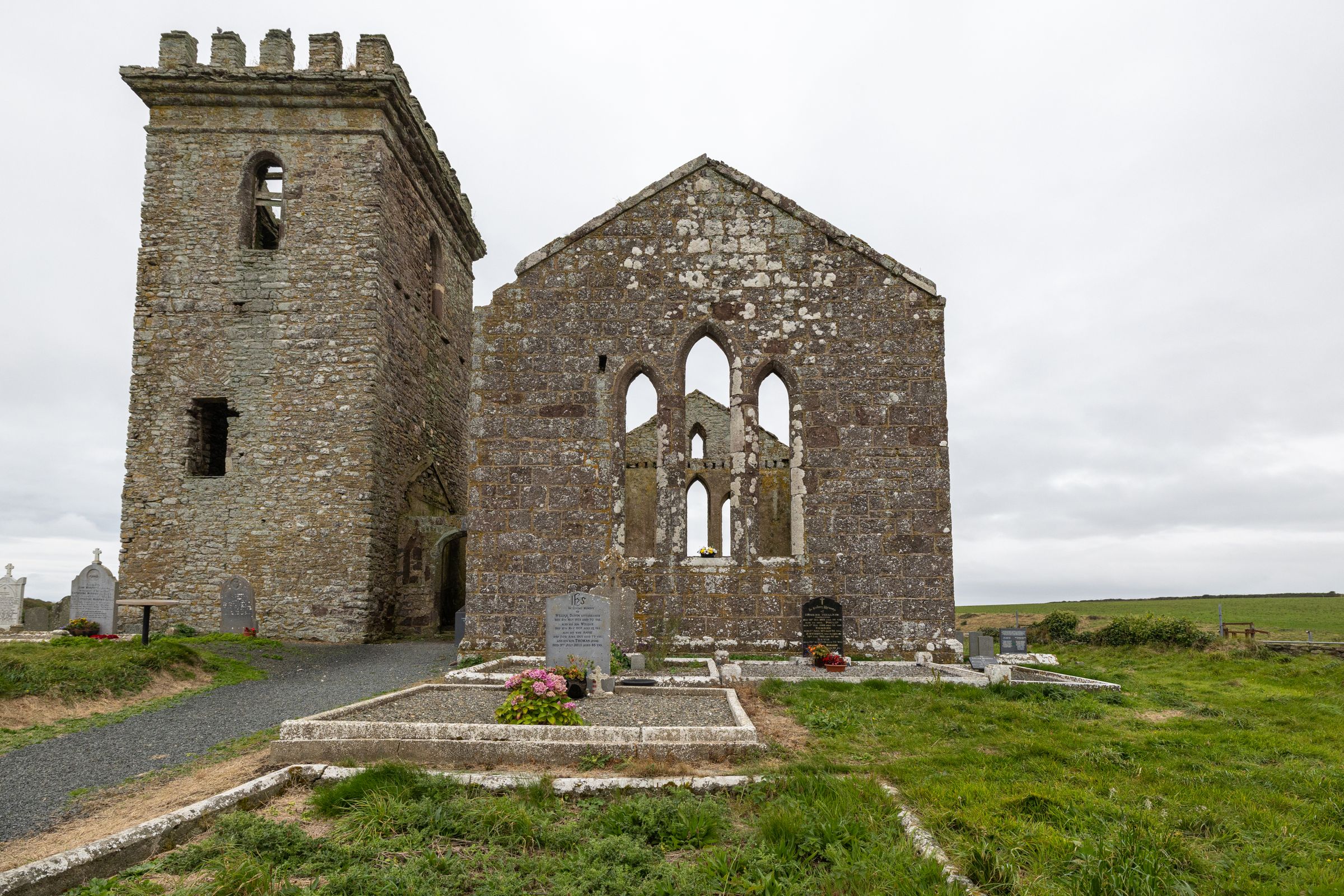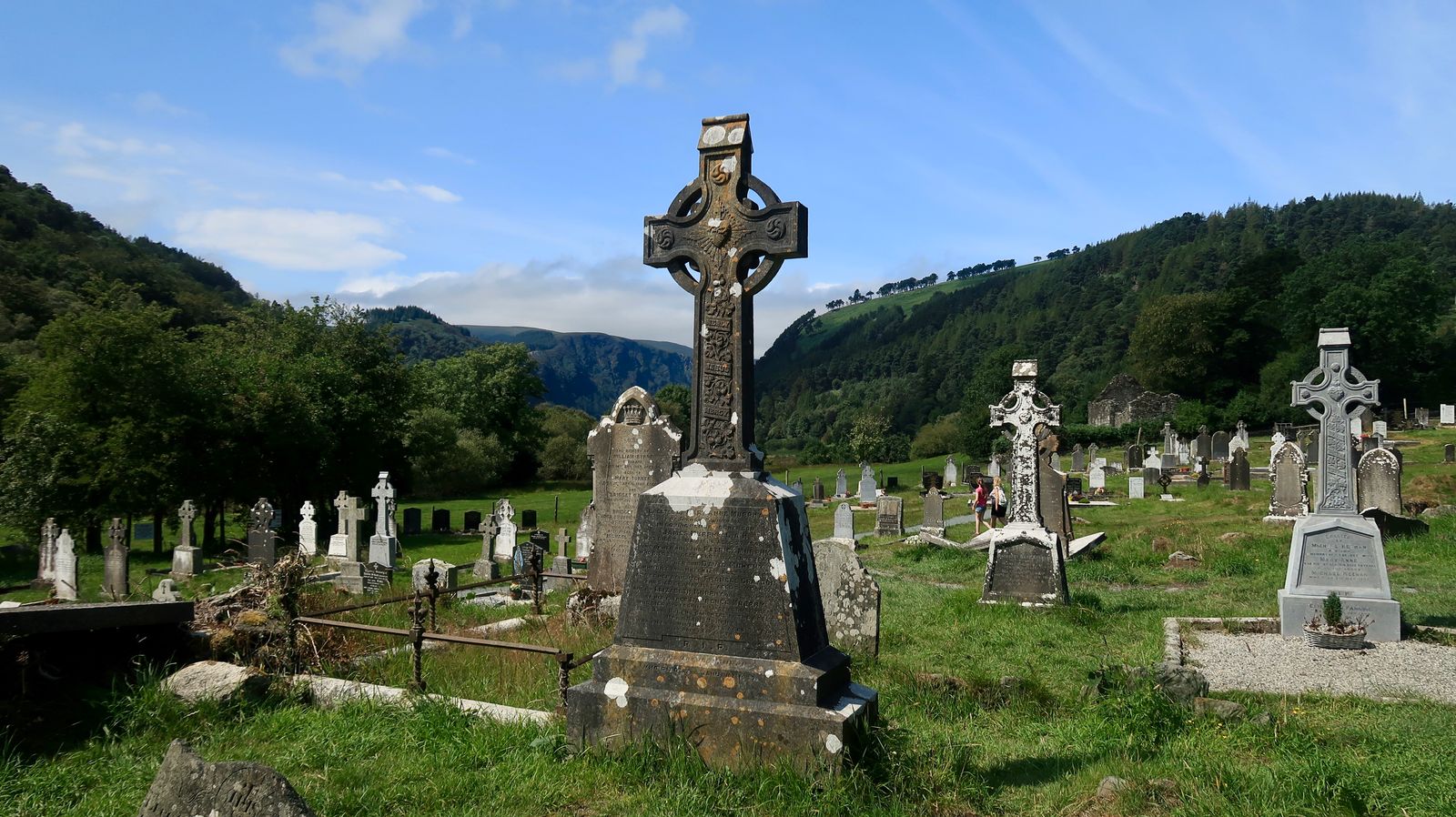
The high crosses are tall stone crosses, most of them ringed, carved with panels of figures and ornament. They were raised at Irish monasteries between roughly the ninth and twelfth centuries. Several of the best known stand in County Louth and County Meath, an hour or so north of Dublin.
What a high cross is
A high cross is a free-standing stone cross, usually with a ring linking the four arms. Most stand on a stepped base and are made from a single block of stone, though some are assembled from several. They are found in monastic graveyards and at church sites, often beside a round tower or ruined church.
The ring is the feature that distinguishes the Irish type from a plain cross. It gives the arms structural support and creates a circular frame around the intersection. Carving covers the shaft, the arms and the ring, and the base often carries a decorative panel too.
Sizes vary widely. Some crosses are little more than a metre tall, while the tallest reach several metres. Many have weathered badly, and a few have lost their heads or arms. Where a cross is badly worn, a cast or replica is sometimes displayed instead, with the original kept under cover.
Monasterboice, County Louth
Monasterboice is a monastic site a few kilometres inland from the coast between Drogheda and Dundalk. It holds a round tower, the stump of a second tower, two ruined churches and three high crosses, all in a walled graveyard. The site is in the care of the Office of Public Works and is free to walk around.
Two of the crosses here carry dense figure carving. The panels run in sequence up the shaft and around the ring, and the subjects are mostly scenes from the Old and New Testaments. A long cross nearer the gate is plainer but still shows figure carving at the centre.
The graveyard is still in use and the ground is uneven. The crosses stand in the open with no shelter, so a waterproof jacket is useful. The nearest towns for a base are Drogheda to the south and Dundalk to the north, both with rail stations on the Dublin to Belfast line.
Kells and the Book
Kells in County Meath was a major monastery, and the high crosses in its churchyard belong to that foundation. The town is better known for the Book of Kells, the illuminated manuscript associated with the monastery, which is now kept in Dublin. The crosses themselves stay in the town.
Several crosses and cross shafts stand in the grounds of the church, some of them moved there for protection. Carving survives on the shafts, though weathering has taken a toll. A short walk through the town links the churchyard with the round tower and other monastic remains.
Kells is about an hour by road from Dublin and sits close to the Boyne Valley, so it fits naturally into a day that also takes in other sites in the area. Navan is the nearest larger town for a base, and there are buses from Dublin to Kells.
Opening arrangements at churchyard sites can change: check with the Office of Public Works or the local parish before travelling.
Clonmacnoise on the Shannon
Clonmacnoise stands on the east bank of the Shannon in County Offaly, on a low ridge above the river. It was one of the great monastic centres of early Ireland, and the site holds two round towers, a cathedral, several small churches and a collection of crosses and cross slabs.
The crosses here are displayed in and around the ruins, and some are protected by modern shelters. The visitor centre explains the monastic layout and the carving. Entry to the site is ticketed, and the Office of Public Works runs it.
The setting is open and exposed, with the river on one side and bog and pasture on the other. Athlone is the nearest town of any size and makes a practical base, with rail and bus connections. The site is a short drive from the town, and the roads are quiet.
How to read the carving
The panels on a high cross are not random decoration. They usually show scenes that a congregation would have recognised: Adam and Eve, the sacrifice of Isaac, Daniel in the lions' den, the baptism of Christ, the crucifixion and the last judgment. The order often runs from the base upwards.
Because the carving is shallow and the stone is worn, the figures can be hard to make out in flat light. Early morning or late afternoon, when the sun is low, brings out the relief. A torch or a phone light can help on a dull day, though some sites discourage touching the stone.
Interpretation panels at the main sites identify the scenes, and guidebooks and the Office of Public Works publications cover the subject in more detail. Knowing a few of the standard scenes makes the crosses much easier to follow.
For detailed reading of the panels, check what interpretation the Office of Public Works provides at each site before setting out.
Where to base yourself
Dublin is the practical base for the crosses of Louth and Meath. Monasterboice and Kells are both within a day's drive of the city, and the Dublin to Belfast rail line serves Drogheda and Dundalk for the northern sites. A car makes the churchyard sites much easier to reach.
For Clonmacnoise, Athlone is the obvious base, sitting on the Shannon with rail and bus links. Kilkenny and Waterford are further south and suit a wider tour of the midlands and south east, though the drive to Clonmacnoise is longer.
Wherever you stay, allow for the weather. The sites are mostly open ground with little shelter, and rain is possible in any month. A base with a town centre within walking distance makes a wet afternoon easier to manage.
Visiting the sites
Monasterboice and the Kells churchyard are open ground and free to walk, though the churches themselves may be locked. Clonmacnoise has a visitor centre and a charge applies. Opening times vary by season, so check with the Office of Public Works before travelling.
The ground at all these sites is uneven, with gravel paths, grass and old stone steps. Sturdy shoes are sensible. Some crosses stand in active graveyards, so keep to the paths and respect any funeral or maintenance work taking place.
Photography is generally allowed, but flash and tripods may be restricted in shelters and visitor centres. Check locally. The crosses are fragile and centuries old, so do not climb on the bases or touch the carved surfaces.
Seasonal opening at Clonmacnoise changes through the year: confirm times with the Office of Public Works before you travel.