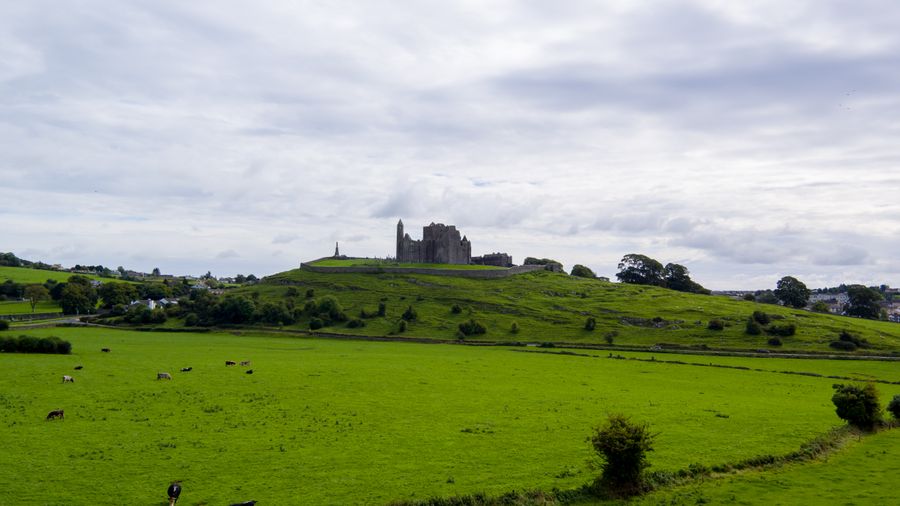
Clonmacnoise stands on a low gravel ridge above the River Shannon in County Offaly, a short drive south of Athlone. The site holds ruined churches, two round towers and a collection of carved high crosses, with the river and wet meadows on every side.
The monastery
Clonmacnoise was founded in the sixth century on a crossing point of the Shannon, where an old road met the river. It grew into one of the larger monastic settlements of early Ireland, with churches, workshops, a scriptorium and a community of scholars and craftsmen. Pilgrims came from across the midlands and beyond.
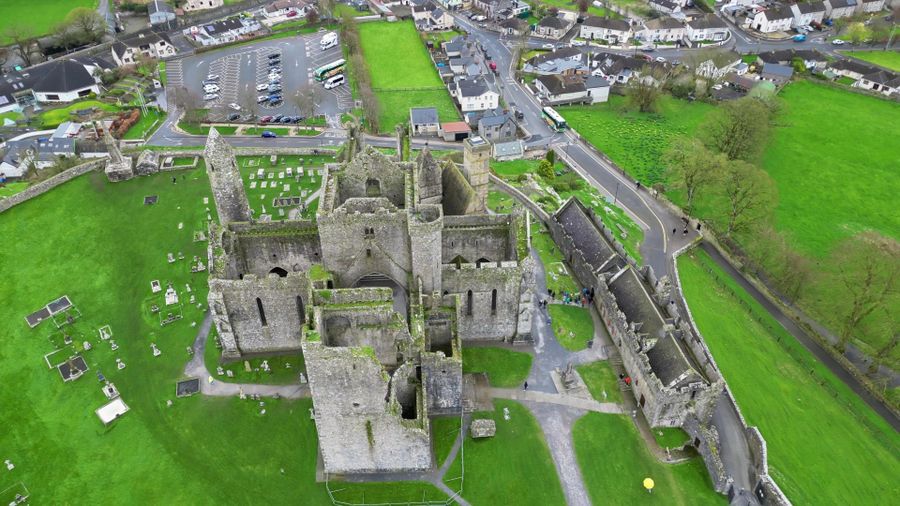
The site was raided repeatedly over the centuries, by Irish kings and by Viking and Norman forces, and was finally suppressed in the sixteenth century. What survives is a compact group of ruined buildings inside a walled graveyard, with several small churches, two towers and a scatter of carved stones.
The whole site sits on the floodplain, so the ground can be soft after rain. A path runs from the car park and visitor centre down to the ruins, with the river visible beyond the graveyard wall. The setting is quiet, open and exposed to the weather.
The site is run by the Office of Public Works. Check Heritage Ireland for current opening times and last entry before travelling.

The high crosses
Clonmacnoise is known for its carved stone crosses, several of which stand in the graveyard or are kept under cover in the visitor centre. The Cross of the Scriptures is the best known, cut from sandstone and covered in figure carving on all faces.
The faces of the cross show scenes from the Bible, along with a panel that is usually read as the founding of the monastery. The carving is worn but still legible in good light, and a cast copy stands outside where the original once stood.
Other crosses on the site include the North Cross and the South Cross, both fragmentary. Because the originals are exposed to weather, some carved stones are displayed indoors. A short look at the exhibition before walking the graveyard helps make sense of what survives.
The round towers
Two round towers survive at Clonmacnoise. Temple Finghin, near the river, has a tower attached to a small church, and O'Rourke's Tower stands at the other end of the graveyard. Both are built of local stone and taper slightly towards the top.
O'Rourke's Tower lost its upper storey in a storm, so it is shorter than many round towers elsewhere on the island. The towers were built as bell towers and as places of refuge, with a doorway raised well above ground level and reached by a ladder that could be pulled inside.
The towers are closed to climbing. They are best seen from the graveyard paths, where their full height shows against the sky and the flat ground around the Shannon. In low evening light the stone takes on a warm colour, and the towers stand out clearly across the callows.

The visitor centre
The visitor centre holds an exhibition on the monastery and its history, with original carved stones moved indoors for protection. It also has a short audiovisual presentation on the site, which sets out the sequence of building and rebuilding over the centuries.
Entry to the site is ticketed, and the centre is the place to pay and to pick up information. Opening hours vary through the year, and the ruins themselves can be viewed from outside the wall at any time, though the interior and the exhibition close with the centre.
Facilities are modest: there is parking, toilets and a small area for visitors. There is no village at the site, so food and drink are best arranged in Athlone or Shannonbridge before or after a visit. Allow time for the exhibition rather than treating the centre as a quick stop.
Opening times change with the season. Confirm them with the Office of Public Works through Heritage Ireland before setting out.
Beside the Shannon
The River Shannon runs past the foot of the site, wide and slow here, with callows and wet meadow on the far bank. The river was central to the monastery: it brought people, goods and pilgrims, and it linked Clonmacnoise to the wider midlands and to the sea.
A short walk leads down towards the water, where the ground is often damp. The Shannon Callows are a haven for birds, and waders and wildfowl can be seen along the margins in the right season. Binoculars are useful, and the far bank is best scanned from the higher ground near the ruins.
Boats have long used this stretch of the river, and a modern mooring serves craft on the Shannon navigation. The river remains a working waterway as well as a place to walk and watch. Water levels change with rain, so the meadow edge can be muddy or briefly under water.
Around the site
Shannonbridge, a small village a few kilometres to the south, sits at a crossing of the Shannon and has a riverside setting. Athlone, further north, is the largest town in the area and has the widest choice of places to stay and eat, along with a castle and a riverside walk.
The monastic site at Clonmacnoise can be combined with a drive along the Shannon or with a visit to Athlone Castle. The flat land around the river is quiet and good for short walks, and the minor roads are light on traffic outside busy periods.
For a longer day, the bog roads and minor roads of County Offaly and County Roscommon cross the midlands. Distances are short by car, but public transport to the site itself is limited. A base in Athlone suits a visit here well, with Galway and the west within easy reach by road or rail.
Practical notes
Clonmacnoise is reached by minor roads from Athlone, Shannonbridge and Ballinahown. The lanes are narrow in places and can flood after heavy rain, so allow time and drive with care. Traffic drives on the left, as everywhere on the island.
Public transport to the site is limited. Buses run to Athlone and Shannonbridge, and the final stretch is usually covered by car, bicycle or on foot. Check with Bus Éireann and Transport for Ireland for current routes, as timetables change through the year.
The weather is changeable, and the site is exposed beside the river. Waterproof clothing and sturdy shoes are sensible at any time of year, and the ground can be uneven underfoot. There is little shelter among the ruins, so a windproof layer earns its place even on a bright day.