Irish dancing covers more than the stage shows. Céilí dancing is done in groups of two to eight in a square or line, set dancing takes its figures from old quadrilles, and sean-nós is a solo style with a low, close step. All three are social, and visitors are welcome at many classes and gatherings.
Three kinds of dancing
Céilí dancing is the group form most often taught to visitors: sets of two, four or eight dancers moving through named figures such as the Walls of Limerick or the Siege of Ennis. Set dancing is related but looser, danced by four couples in a square, with figures drawn from nineteenth-century quadrilles and a strong local accent in each region. Sean-nós is a solo dance, low to the ground, with the emphasis on the rhythm of the feet rather than height or leaps.
The three forms share a musical base: reels, jigs and hornpipes played on fiddle, flute, accordion, concertina and bodhrán. A caller or a teacher names the figure before it starts, so a beginner can follow. Sets vary from place to place, and a set danced in Clare may not be the same as one danced in Donegal.
Competition dancing, the stiff-armed style seen in championships and stage shows, is a separate world with its own schools and grades. It is worth knowing the difference, because a visitor looking for a social evening wants a céilí or a set, not a feis.
Where to watch
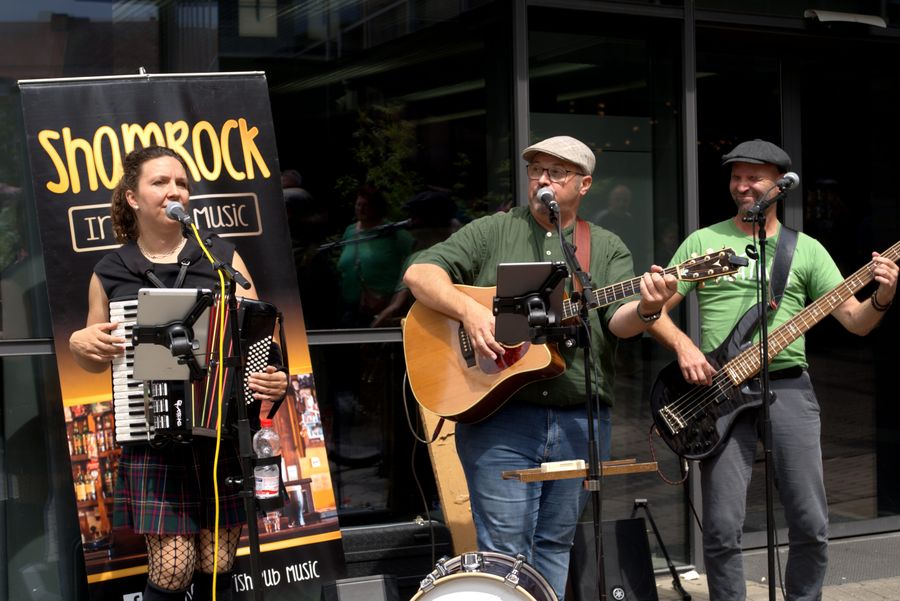
Traditional music sessions in pubs sometimes turn into a dance, especially in the west. Summer brings céilithe in halls and marquees in many towns, often run by local branches of Comhaltas Ceoltóirí Éireann, the body that promotes traditional music and dance. These are usually ticketed or take a collection at the door.
Cultural centres and museums in the cities stage demonstrations, and the larger towns hold summer schools and festivals with dancing in the programme. Galway, Sligo, Ennis, Listowel and Dingle all have a reputation for traditional music, and where there is music there is often dancing.
The Fleadh Cheoil, the annual festival run by Comhaltas, moves between towns and draws dancers and musicians from across the island and abroad. Dates and venues change each year, so check with Comhaltas before planning a trip around it.
Joining a class
Many towns have a weekly set dancing or céilí class, often in a hall or a community centre, and visitors are generally welcome to watch first and join later. Classes usually run through the autumn and winter and pause or thin out in summer. A teacher will pair newcomers with experienced dancers.
No special clothing is needed for a beginner class: soft shoes or trainers are fine, and hard shoes are only for the more advanced forms. Expect to be taught one figure at a time, then to dance it to music. The learning is by repetition rather than by reading.
If you want a single evening rather than a course, look for a céilí night or a workshop attached to a festival. Tourist offices and local arts centres can point to what is running in a given week, and Comhaltas branches list their own events.
Class times and seasons change: check with the local Comhaltas branch or the town's arts centre before travelling to a class.
Sean-nós and the older style
Sean-nós dancing is the older solo tradition, strongest in Connemara, west Kerry and parts of Donegal. The dancer stays close to the floor, with small, precise steps and an emphasis on the beat. The arms are loose and the upper body relaxed, unlike the stiff carriage of competition dancing.
It is often danced to a single musician or a singer, and it can happen in a kitchen as readily as on a stage. The style has regional variations, and dancers learn by watching as much as by formal teaching. Competitions and demonstrations at festivals are a good place to see it.
The word sean-nós means old style, and it is also used for unaccompanied singing in Irish. The two traditions share a setting and an audience, and a night of sean-nós singing often includes dancing.
Music and the Irish language
Dancing depends on the music, and the tunes are named in Irish and English: the jig, the reel, the hornpipe, the slide and the polka. Polkas and slides are especially common in Kerry and west Cork, where set dancing has a strong following.
Many céilí calls are given in Irish, and the names of the figures are often Irish too. A caller will usually explain in English for visitors, but learning a few words helps: rince for dance, céilí for a gathering, and foirne for a set.
Gaeltacht areas, where Irish is the community language, keep the older forms alive. In Connemara, the Dingle Peninsula and parts of Donegal, a summer evening may bring music and dancing in a local hall. Road signs there are in Irish only, so a map helps.
Where to base yourself
The booking search on this page is set to Doolin, a village in north Clare with a long association with traditional music. It is a good base for a visitor who wants music in the evening and the Burren and the Cliffs of Moher by day. Ennis, the county town, has more choice of accommodation and its own traditional music scene.
Galway city is the strongest base for a mix of classes, sessions and festivals, with Connemara within easy reach for sean-nós and Irish-language events. Sligo and Donegal suit a quieter trip with music in smaller towns, and Listowel in Kerry is known for its summer festival of music and dance.
Cork city and west Cork hold set dancing classes and summer events, and Dublin has classes in most suburbs plus the larger cultural venues. Wherever you base, a car makes evening events easier, since rural halls are rarely on a bus route. Transport for Ireland has a journey planner for the routes that do exist.
Rural halls are often off the bus network: check timetables with Bus Éireann or TFI Local Link, or plan to drive.
At a céilí or session
A céilí is a social event, not a performance, and newcomers are expected to join rather than sit out. If a set needs a fourth couple, someone will ask. Saying yes is the easiest way in, and mistakes are corrected as the dance goes.
At a session in a pub, the musicians set the pace and the dancing happens in whatever floor space there is. Buy a drink, keep quiet during a slow air, and ask before taking photographs. Applause between tunes is fine; talking over the music is not.
Children are welcome at most céilithe, and family events are common in summer. Doors open early in the evening, and events usually finish before midnight. Check locally for whether an event is ticketed or takes a collection.