Soda bread is the loaf most associated with Irish kitchens: four everyday ingredients, a hot oven and no rising time. It turns up beside soup, under smoked salmon and at breakfast, and it is easy to find in Cork, where the booking search on this page starts.
What soda bread is
Soda bread is a quick bread raised with bread soda rather than yeast. Bread soda is another name for bicarbonate of soda, an alkali that reacts with the acid in buttermilk and gives off gas, so the loaf rises in the oven without any proving. The usual ingredients are plain flour, buttermilk, salt and bread soda, and nothing else is needed.
Because there is no yeast, there is no waiting. A loaf can be mixed and in the oven within minutes, which is why it suited kitchens where bread was made daily and nobody had time to tend a dough. The texture is denser than a yeasted loaf, with a close crumb and a crust that is best eaten the day it is baked.
The version most people mean is white soda bread, made with plain white flour. A brown version uses wholemeal flour, which gives a heavier loaf with more flavour. Both are made the same way, and both are still baked at home and sold in bakeries and shops across the island.
How the rise works
The reaction is simple chemistry. Buttermilk is slightly acidic, and bread soda is alkaline, so when the two meet they fizz and release carbon dioxide. That gas is trapped in the dough and expands in the heat of the oven, lifting the loaf. Too little soda and the bread is flat and heavy; too much leaves a soapy taste and a yellowish crumb.
The balance is why recipes give measured amounts and why the buttermilk matters. If ordinary milk is used, an acid such as lemon juice or vinegar is added to sour it first. The reaction starts as soon as the wet and dry mixes meet, so the dough is handled quickly and shaped at once rather than kneaded for long.
A cross is cut into the top of the round before baking. It is usually explained as letting the heat in and helping the loaf open evenly, and it also gives the traditional four quarters that are pulled apart or cut. The cut is practical, not ceremonial, though it has picked up plenty of folklore over the years.
Baking at home
Most soda bread is baked in an ordinary oven, hot and preheated, on a floured tray or in a heavy tin. The loaf is round and fairly flat, and it bakes in well under an hour. It is done when the base sounds hollow when tapped, and it is left to cool a little before cutting, because a hot loaf straight from the oven can be gummy inside.
Older kitchens used a pot oven, a heavy lidded pot set over the fire with hot turf or coals on the lid, which baked the bread from above and below. The same method survives in camps and open fires. A cast iron pot in a domestic oven does much the same job and gives a steady, even heat.
Soda bread does not keep well, which is part of its character. It is at its best on the day it is made, and after that it is better toasted or used for breadcrumbs than eaten plain. That short life is one reason it stayed a home loaf rather than a long-distance one.
Self-catering kitchens usually have what is needed. Flour and buttermilk are sold in supermarkets on both sides of the border; check labels, as flour names differ slightly.

How it is eaten
At its plainest, soda bread is sliced and buttered, warm or toasted. It goes with soup, with a fry, with cheese, and with smoked salmon, where brown soda bread is the usual partner. It is also the bread served alongside seafood chowder in many parts of the west and south coasts.
Brown soda bread made with wholemeal flour is the more common restaurant version, often with seeds added to the top. White soda bread is more of a home and bakery loaf, sometimes baked with currants or caraway as a fruit bread, which is a different thing again and closer to a tea bread than to the everyday loaf.
In Northern Ireland, which is part of the United Kingdom, soda bread sits alongside potato bread and wheaten bread on the breakfast table, and the vocabulary differs: wheaten bread is the usual name for the brown loaf there. The ingredients and method are much the same on both sides of the border.
Where to taste it
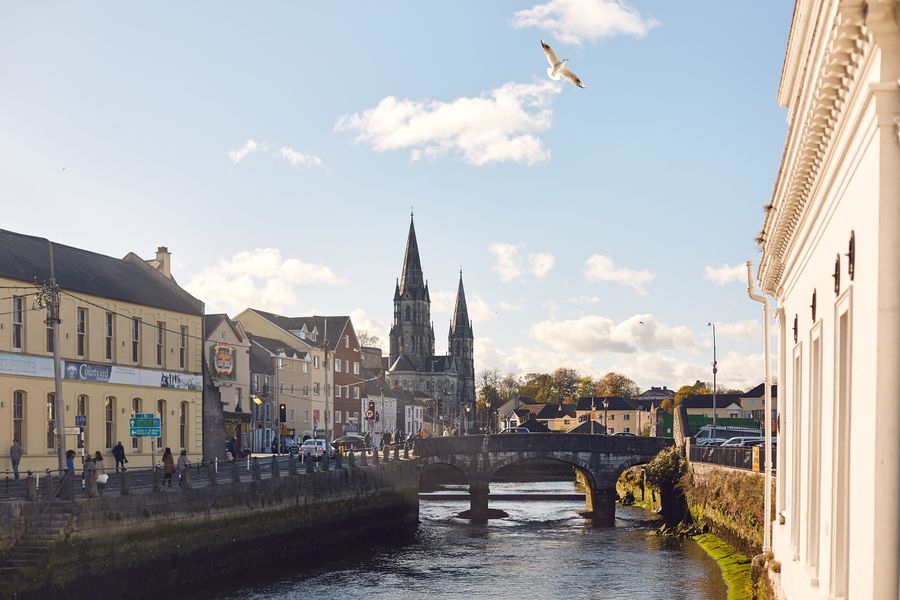
Soda bread is not tied to one county, and it is sold and served all over the island. The booking search on this page is set to Cork, which is a good place to start: Cork city has bakeries, markets and cafés where it appears daily, and the English Market in the city centre is a place to see bread sold alongside other local food.
West Cork, from Clonakilty and Skibbereen out to Schull and Bantry, has a strong food culture and plenty of places where brown soda bread comes with soup or seafood. Kinsale, a harbour town south of the city, is another good base, with a compact centre and a short drive to the coast.
For a wider choice of bases in the region, the Cork city and West Cork pages cover towns and transport in more detail. Wherever you stay, the loaf is a shop and café staple rather than a speciality you have to hunt down, and it is often cheapest and freshest from a local bakery.
Cork city suits a stay without a car, with buses and trains from Kent station. West Cork and Kinsale are easier by car; check timetables with Bus Éireann and Iarnród Éireann.

A loaf of hard times
Soda bread as it is known today dates from the middle of the nineteenth century, when bicarbonate of soda became widely available as a raising agent. It spread through Irish households because it needed no yeast, no long proving and no special equipment, and it worked with the soft wheat and the buttermilk that were at hand.
Soft wheat grown in the Irish climate is low in the gluten that suits yeasted bread, so soda bread was a good fit for local flour. Buttermilk came from butter making, which was widespread, so the two ingredients that make the loaf rise were both household staples rather than shop purchases.
The loaf is often described as a food of shortage, and there is truth in that: it was cheap, quick and filling. It has since become a marker of Irish identity abroad, served in Irish pubs and exported in mixes, while at home it stayed what it always was, an ordinary bread made when needed.
Practical notes
If you want to bake soda bread while staying in Ireland, self-catering kitchens usually have an oven and a mixing bowl, and the ingredients are in any supermarket. Buttermilk is sold in cartons in the chilled section; if it is not there, ordinary milk with a little lemon juice works. Bread soda is sold as bread soda or bicarbonate of soda.
Flour names differ between the two jurisdictions. In the Republic, plain flour is what most recipes mean by white flour; in Northern Ireland, which uses pounds and miles, the same product is usually sold as plain flour too, but check the label rather than assume. Wholemeal and coarse wholemeal are sold on both sides.
Baking is a wet-day activity, and rain is possible in every month, so a spare afternoon is easy to find. For other indoor options when the weather turns, the rainy days guide covers museums, galleries and covered markets across the island, including several in Cork and Dublin.
Choosing a base
Cork city is the obvious base for a first visit to the county. It has the markets, the museums and the food, and it is compact enough to walk. Trains and buses run from the city to towns along the coast, and the airport is a short drive west of the centre.
Kinsale, about half an hour south of the city, is a small harbour town with a tight centre and a good range of places to eat. Clonakilty, further west, is a market town with a lively centre and easy access to the beaches around Inchydoney and the coast road towards Skibbereen and Bantry.
For a quieter stay, Skibbereen and Schull sit deep in West Cork, close to the water and the islands. All of these towns are covered in more detail on the Cork city and West Cork pages, which set out transport, parking and what is nearby.