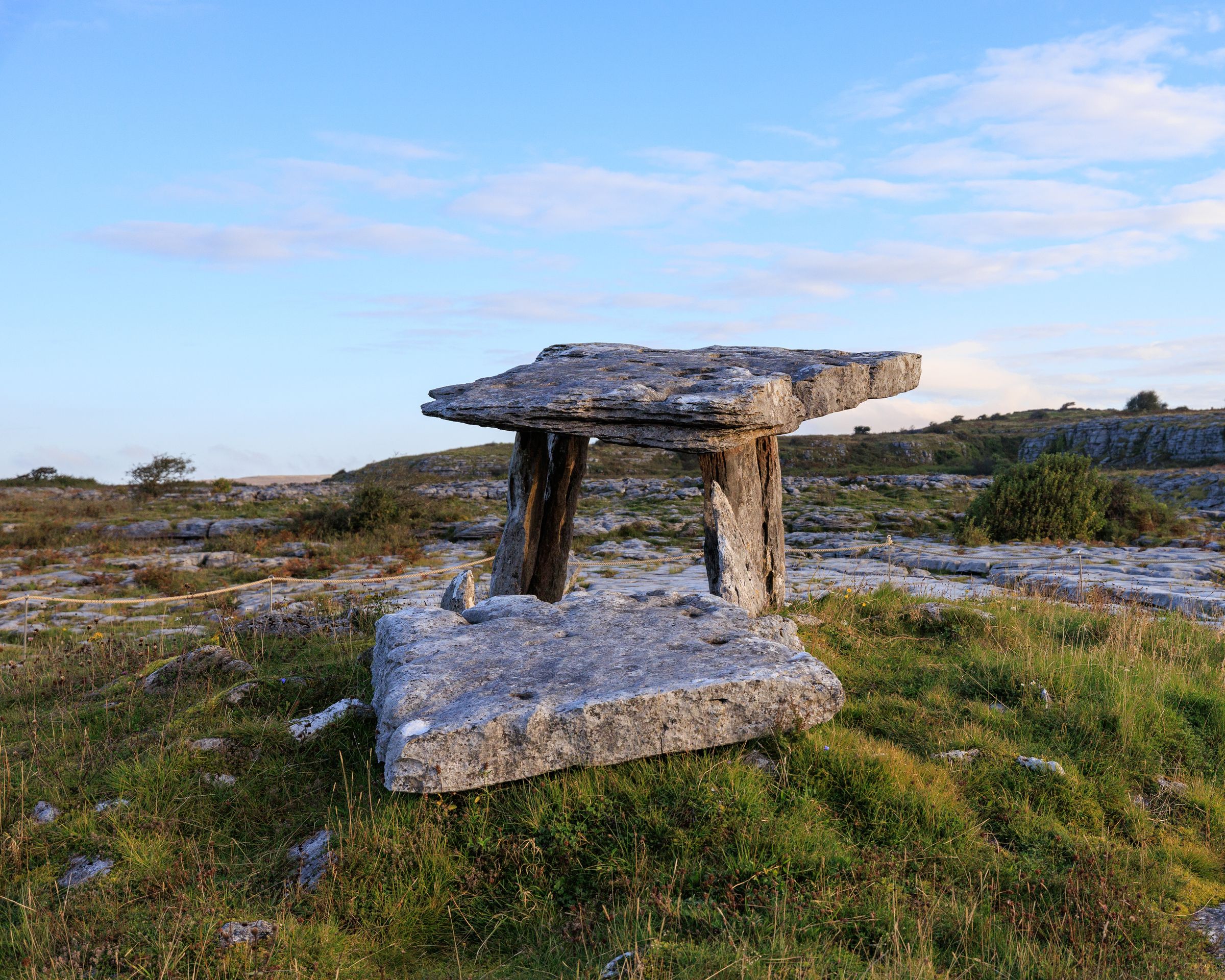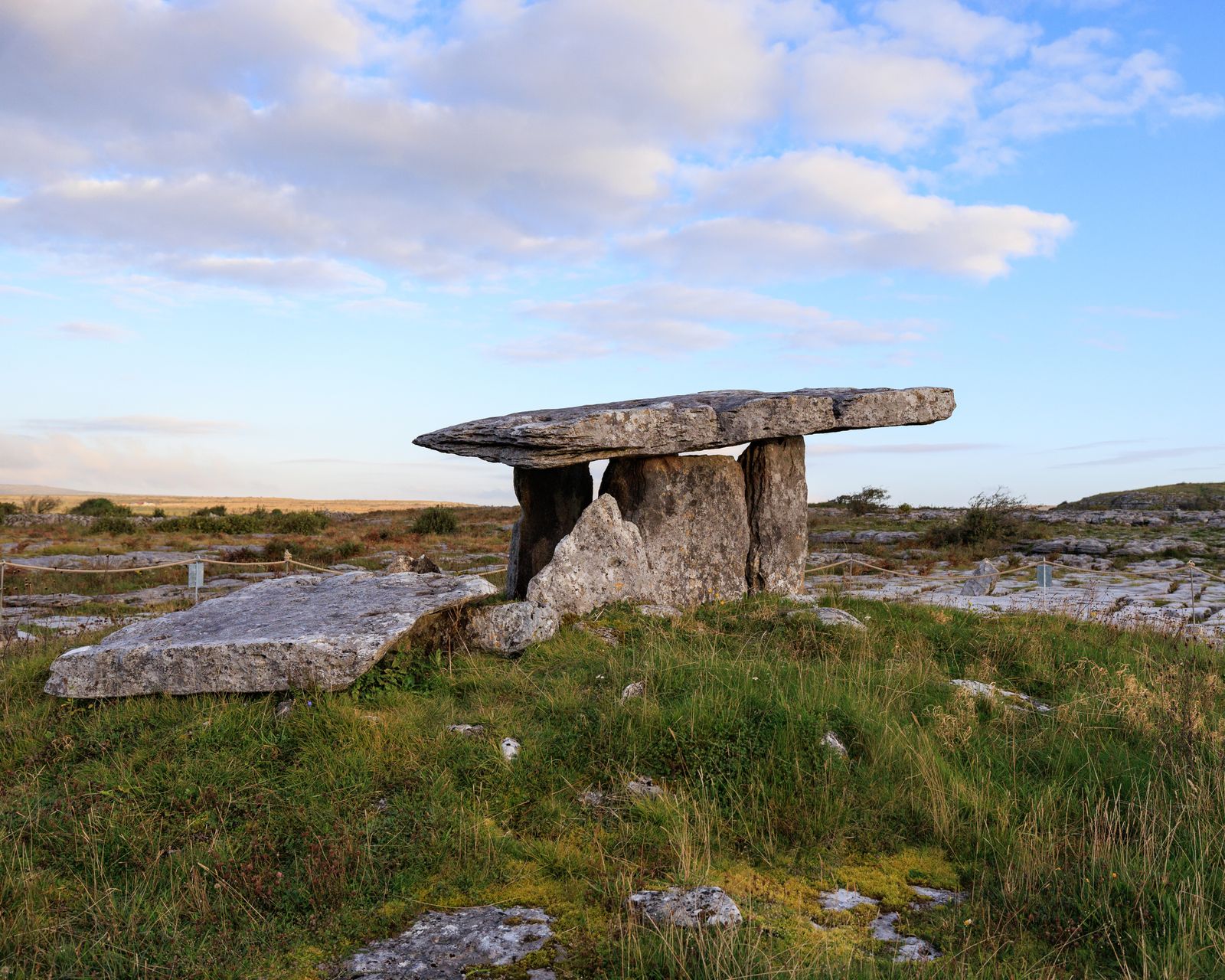
Poulnabrone Dolmen stands on a bed of bare limestone in the middle of the Burren, in County Clare. Two upright stones frame a low entrance, a large capstone rests on top, and a cairn of smaller stones spreads around the base.
The monument itself
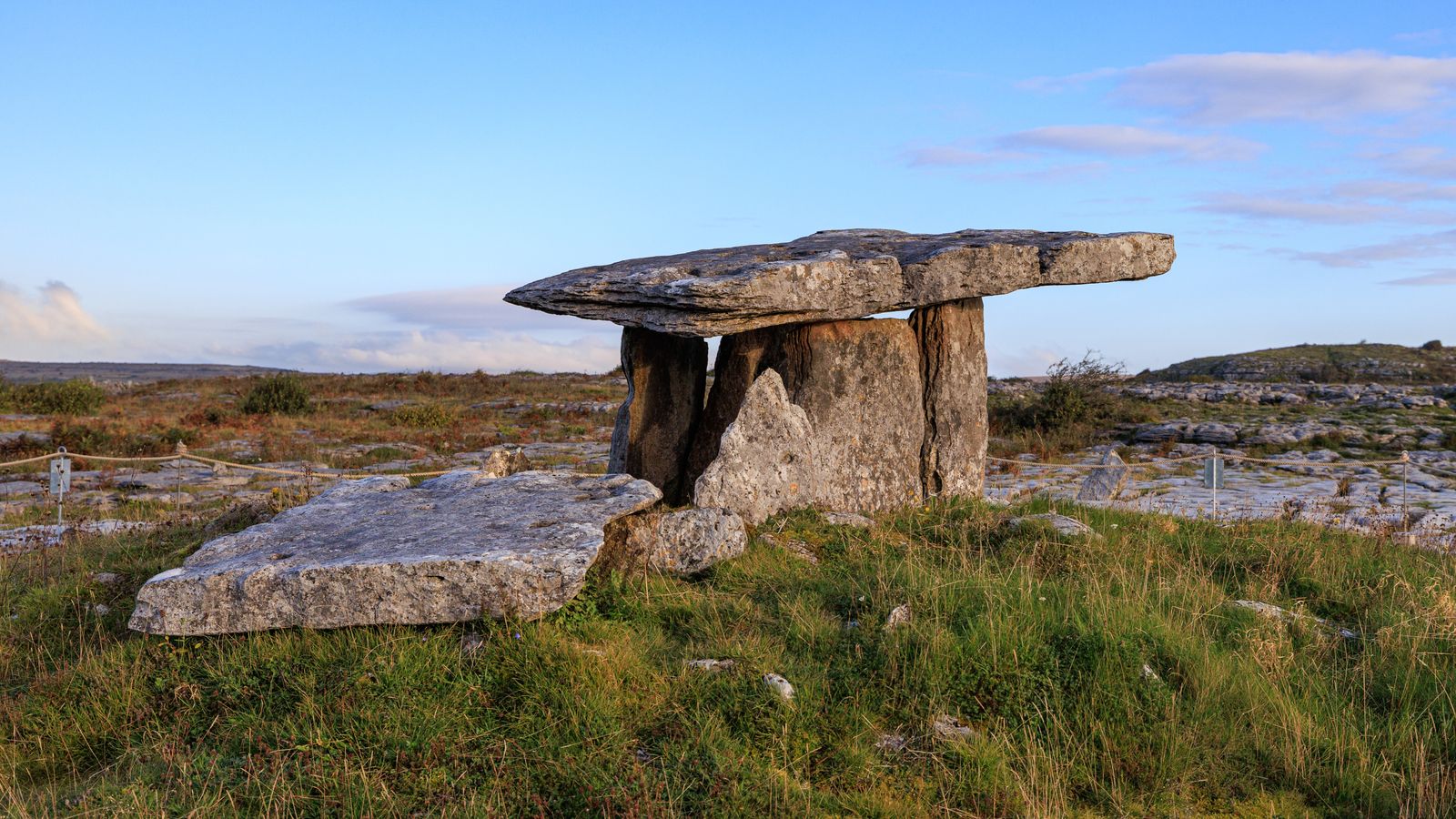
Poulnabrone is a portal tomb, a type of megalithic grave found across Ireland. Two tall upright stones form the portal at the front, a lower backstone closes the chamber, and a single capstone spans them. The stones are local limestone, and the capstone is the heaviest element, resting on the two portals and the backstone.
The chamber sits within a low cairn of stones that has been partly reconstructed. The monument is a scheduled national monument, cared for by the Office of Public Works. Visitors walk up to it on open ground, and there is no building or gate at the site itself.
The name is usually given as Poll na Brón, often translated as the hole or pool of the quern. The monument is one of several megalithic tombs in the Burren, and it is the one most visitors see, because it stands close to a public road on open pavement.
The Burren setting
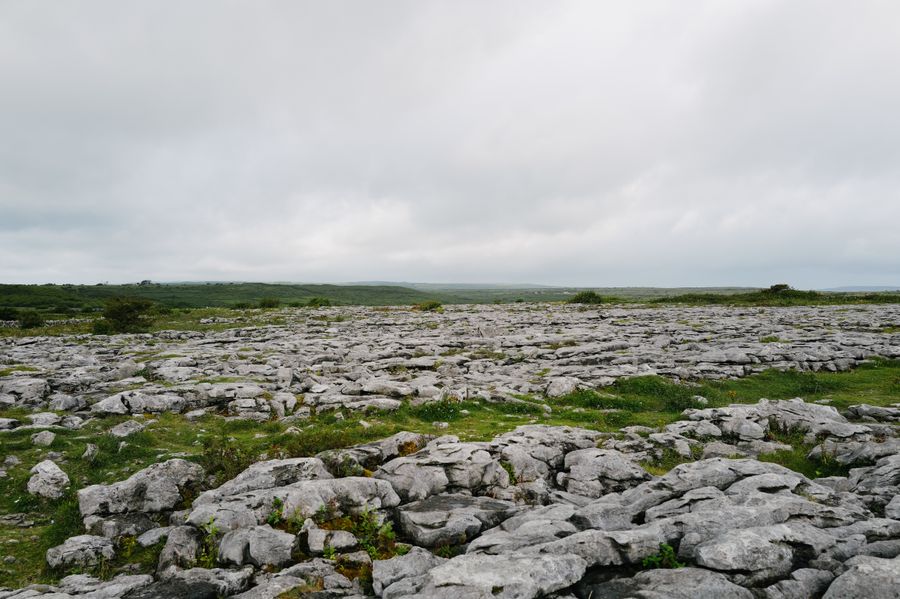
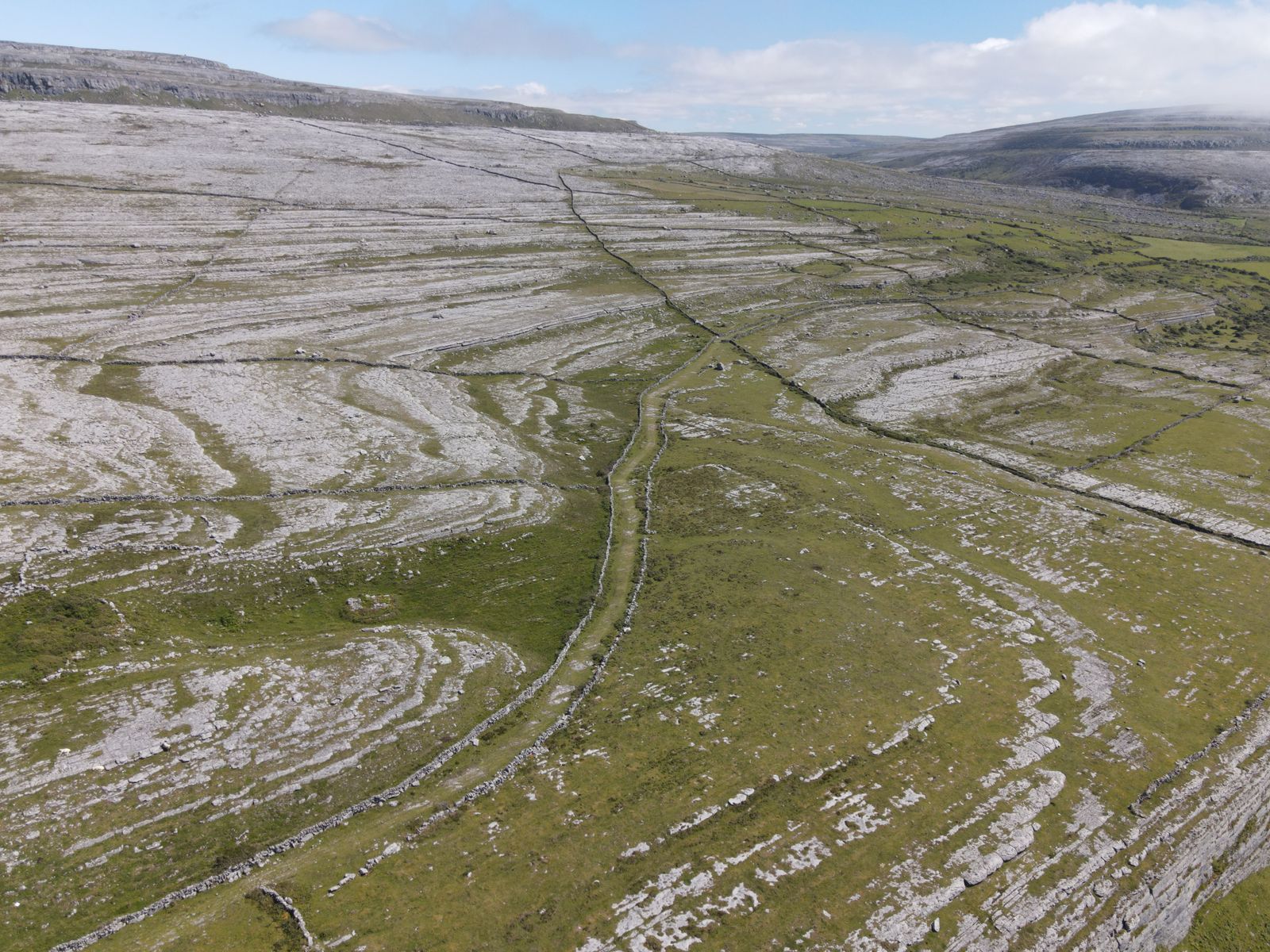
The Burren is a limestone region that covers much of north Clare. The rock lies bare in wide sheets, split by cracks called grikes, with small plants growing in the shelter of the fissures. Poulnabrone stands on one of these open pavement areas, with a low ridge of hills to the north and east.
The landscape around the dolmen is open and exposed. There is little shelter, and the wind crosses the limestone without interruption. On a clear day the views run across the pavement to the surrounding hills, and the light changes quickly as cloud moves over.
The Burren is a protected landscape, and much of it falls within the Burren National Park, run by the National Parks and Wildlife Service. The park has walking routes and an information point, and the wider region is recognised as a UNESCO Global Geopark for its geology and archaeology.
Getting there
Poulnabrone stands beside a minor road in the townland of Poulnabrone, a short drive from the village of Carran and within reach of Ballyvaughan, Kilfenora and Lisdoonvarna. The approach roads are narrow and winding in places, with grass margins and stone walls, so allow time for the drive.
There is a parking area at the roadside near the monument, and a short walk on a marked path leads to the tomb. The ground is uneven limestone, so sturdy footwear helps. The site is open at all times, and there is no charge to walk to the monument.
Public transport in this part of Clare is limited. TFI Local Link runs some rural services in the county, and Bus Éireann serves the larger towns, but reaching the dolmen without a car takes planning. Check Transport for Ireland for current routes and times before setting out.
The path and pavement are uneven and slippery when wet. Check the weather with Met Éireann before setting out, and wear footwear with grip.
What the stones tell
Portal tombs were built in the Neolithic period, when communities in Ireland had begun farming and settling in one place. The tombs were used for collective burial over time, and excavations at Poulnabrone in the twentieth century recovered human remains from the chamber, along with a small number of artefacts.
The remains showed that the tomb had been used over a long period, with burials placed in the chamber at different times. This pattern is common at megalithic tombs in Ireland, where the structure stayed in use across generations rather than serving a single burial.
The Office of Public Works cares for the monument and the surrounding ground. Visitors are asked to stay off the cairn and not to move stones, since the structure is fragile and the cairn has already been disturbed over the centuries.
Other sites nearby
The Burren holds a dense concentration of archaeological remains. Within a short drive of Poulnabrone there are other megalithic tombs, ring forts, and the remains of early churches. Kilfenora has a cathedral with carved high crosses, and Corcomroe Abbey lies to the north near the coast.
Leamaneh Castle stands to the south east, a ruined tower house with later additions, and the road onwards leads towards Kilfenora and the coast. The Burren Centre in Kilfenora explains the geology and history of the region, and is useful before or after a visit to the monuments.
The Burren National Park has waymarked walking routes on the limestone hills, managed by the National Parks and Wildlife Service. These give a sense of the wider landscape in which the tombs were built, and the park information point can advise on routes and conditions.
Plants and wildlife
The Burren is known for the mix of plants that grow together on the limestone. Arctic and alpine species grow beside Mediterranean ones, sheltering in the grikes and on the thin soil. In spring and early summer the pavement and grassland carry a range of wildflowers.
Birds of prey are seen over the open ground, and the wider region supports a range of farmland and upland birds. The National Parks and Wildlife Service manages the national park and advises on access and wildlife disturbance.
The limestone itself is the reason for the landscape. Rainwater dissolves the rock along cracks, forming the pavement, the grikes and the caves and springs found across the Burren. The Geopark designation recognises this geology and the human history that sits on top of it.
Plants on the pavement are fragile and slow growing. Keep to the path and do not pick flowers. The National Parks and Wildlife Service advises on access in the national park.
Where to base yourself
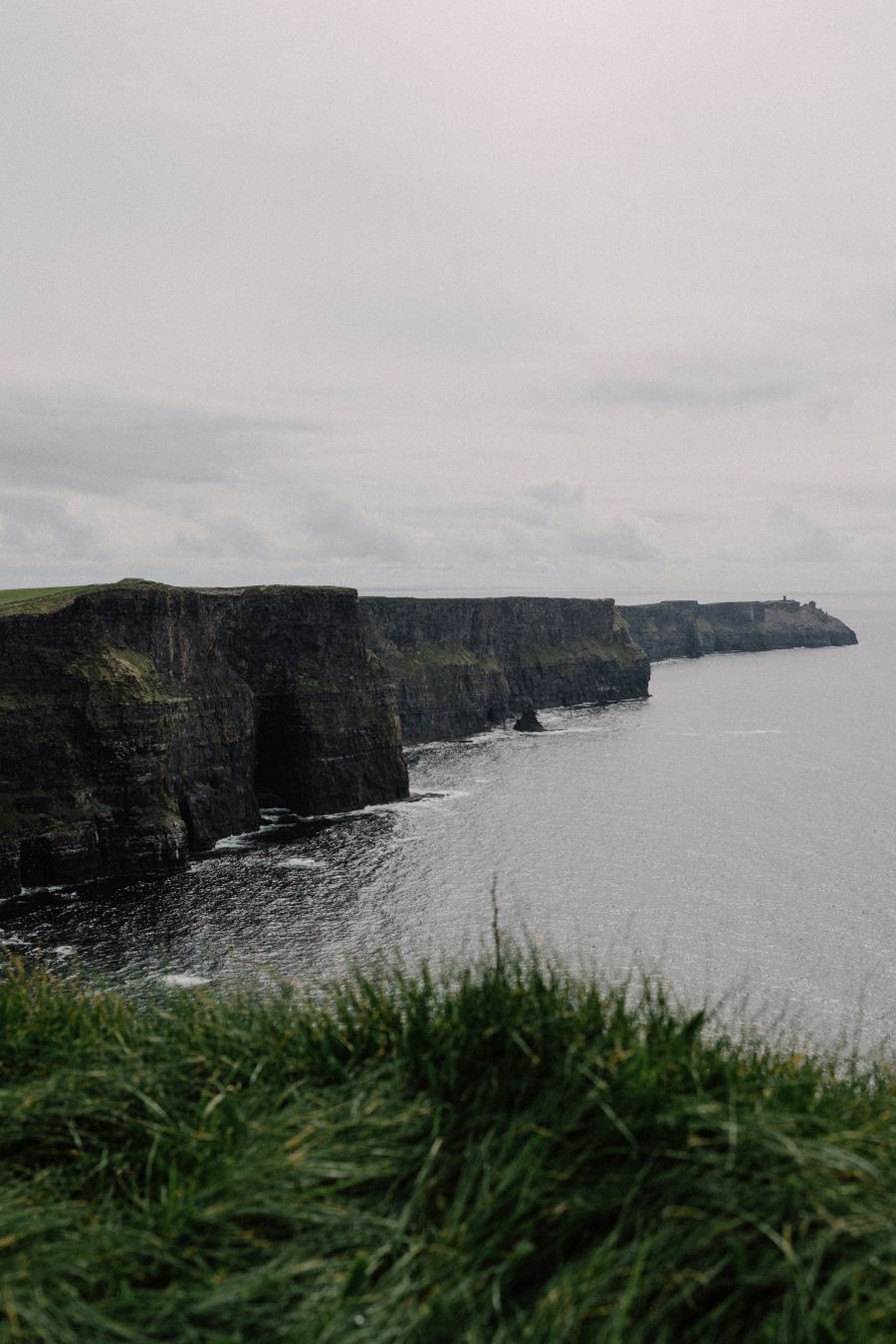
The booking search on this page is set to the Doolin area, which makes a practical base for the Burren and the coast. Doolin has places to stay and is close to the Cliffs of Moher, with the dolmen a short drive inland. Lisdoonvarna, Ballyvaughan and Kilfenora are other options in north Clare.
Ballyvaughan sits on the coast at the northern edge of the Burren, with views across Galway Bay. Kilfenora is inland and central to the monuments, and Ennis, the county town, has the widest choice of accommodation and transport links in Clare.
Galway city is within reach for a longer stay, with the Burren to the south across the bay. Whichever base you choose, a car makes the dolmen and the other sites much easier to reach, since rural bus services are limited and infrequent.
A practical visit
Poulnabrone is a short stop rather than a full day out. Most visitors spend a short time at the monument, walking from the parking area, looking at the stones and the surrounding pavement, and then moving on to other sites in the Burren.
The site is open ground with no facilities. There is no visitor centre, café or toilet at the monument, so plan around the nearby villages. Weather changes quickly on the limestone, and rain and wind are common at any time of year.
Combine the dolmen with the Cliffs of Moher, the Burren National Park or the villages of north Clare. Opening and access arrangements at managed sites can change, so check with the Office of Public Works or the National Parks and Wildlife Service before a visit.