Begin at the Yeats Memorial Building on Hyde Bridge, where the river Garavogue cuts through the town centre. The building houses the Yeats Society and a small exhibition; it is a sensible first stop for orientation rather than a long visit. From here the town is compact enough to walk. The Abbey Quarter, the old courthouse on Teeling Street and the wide sweep of Stephen Street all sit within ten minutes on foot, and the Sligo County Museum on Stephen Street holds a modest Yeats collection including portraits and personal items. Allow an hour for the town centre and check opening times before travelling, as small museums keep short seasonal hours.
Starting in Sligo Town
Sligo is a working town rather than a museum piece, and that is part of its appeal. The Garavogue riverside walk between Hyde Bridge and the R286 takes about twenty minutes at an easy pace, passing the stump of Sligo Abbey with its carved fifteenth-century cloister. If you have arrived by train, Ceannt Station is a five-minute walk from Hyde Bridge, which makes a car-free day feasible. Bus Éireann services from Dublin take roughly three hours; the train from Connolly is comparable and more comfortable. Book a hotel near the town centre if you want to do the town on foot and drive out to the coast the following morning.
Rosses Point and the Coast Road
Drive or take a taxi the eight kilometres west to Rosses Point, where the strand looks across to Oyster Island and the metal man navigation marker. This is the landscape behind much of the early poetry, and the light on a clear afternoon is the reason to come. The promenade walk takes around forty minutes there and back. Do not expect a visitor centre; the appeal is the bay, the beach and the view. The R291 from Sligo town is a straightforward drive of about fifteen minutes outside commuter hours.
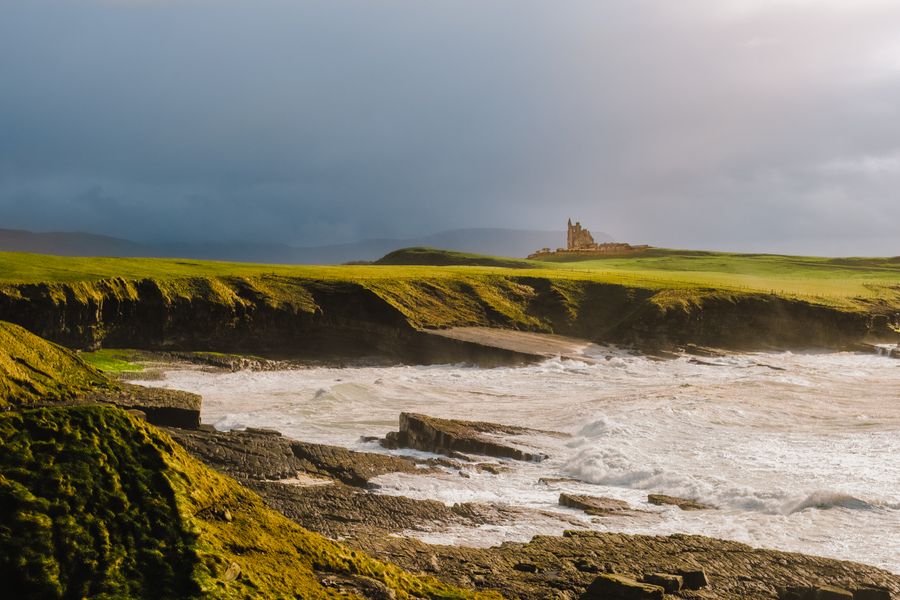
From Rosses Point continue north towards Drumcliff rather than doubling back, which makes a loop of the day. The coast road past Ballincar and Carney is quiet, with views across Drumcliff Bay to Benbulben. Stop at Strandhill if you want a longer break — the beach there is a surfing spot and the village has cafés and a small craft scene. Strandhill is roughly ten kilometres from Sligo town on the R292. Surf schools operate on the beach in summer, and the walk to Killaspugbrone church ruin takes about twenty-five minutes each way over the dunes. This is the stretch to build slack into your schedule rather than rush.
Drumcliff, Benbulben and the Grave
Drumcliff is the essential stop. The churchyard at St Columba's holds Yeats's grave, marked by a plain headstone with the epitaph taken from 'Under Ben Bulben'. The high cross beside the church and the round tower stump are genuine early Christian remains, not reconstructions. The site is small; thirty to forty minutes covers it comfortably. Benbulben rises behind and dominates every photograph. Drumcliff is about eight kilometres north of Sligo town on the N15, a drive of ten to twelve minutes, and lies on the Sligo to Donegal bus route if you are without a car.
The practical question is when to come. May, June and September give the best combination of light and manageable crowds; July and August bring the fullest car parks at Drumcliff and Strandhill. Winter visits are atmospheric but the weather can close in fast on the mountain roads. If you want to see more of the landscape, the Gleniff Horseshoe drive south of Benbulben is a detour of roughly forty minutes and rewards clear weather. Skip it in low cloud. Finish the day back in Sligo town, where the pubs around O'Connell Street and Grattan Street are the natural place to end.
Where to Base Yourself
Sligo town is the right base for a literary day out. Hotels cluster around the centre within easy reach of Hyde Bridge, and you can walk to dinner without worrying about rural roads after dark. Prices in Sligo generally sit below Dublin and Galway for comparable rooms, though summer weekends and the busiest festival periods push rates up; book several weeks ahead if you are travelling in July or August. Staying in Strandhill or Rosses Point suits travellers who want the coast on their doorstep, but you will drive for restaurants and the town museums.
Two nights is the sensible minimum: one for the town and Drumcliff, one for the coast and whatever weather allows. If you are coming from Dublin, the drive on the M6 and N4 takes around two and a half to three hours, and arriving by early afternoon gives you time for Hyde Bridge and the county museum before dinner. Avoid scheduling Drumcliff for a Sunday morning if you want quiet, as it draws steady visitors. My own booking would be a central Sligo hotel for two nights, with the car parked and one full day driving the loop.